Prop firm basics
Understanding What a Prop Firm Is and How It Operates
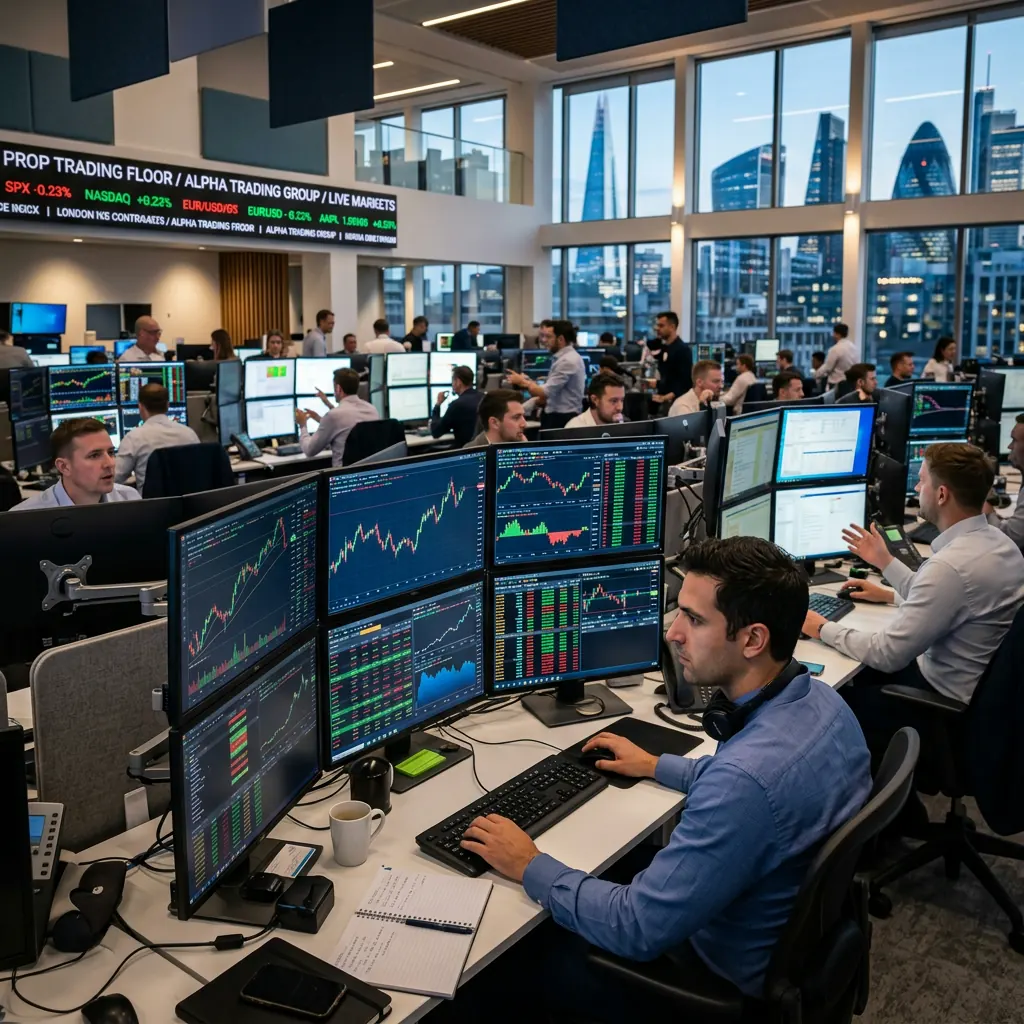
TL;DR 🏦
A prop firm is a company that trades with its own capital and splits the profits with the traders it backs. 🧪 Most retail futures prop firms now sell an evaluation: pass it on a simulated account and you keep 80–100% of what you make on a funded one. Your loss? Capped at the fees you paid.
What is a prop firm? A prop firm (short for proprietary trading firm) is a company that trades the markets with its own money and splits the profits with the traders it backs. In 2026, though, people mostly mean online firms that sell a trading evaluation. You pay a fee, prove you can follow risk rules on a simulated account, then trade the firm's capital for a share of the profits, usually 80–100%.
Introduction to Prop Firms
Definition of a Prop Firm
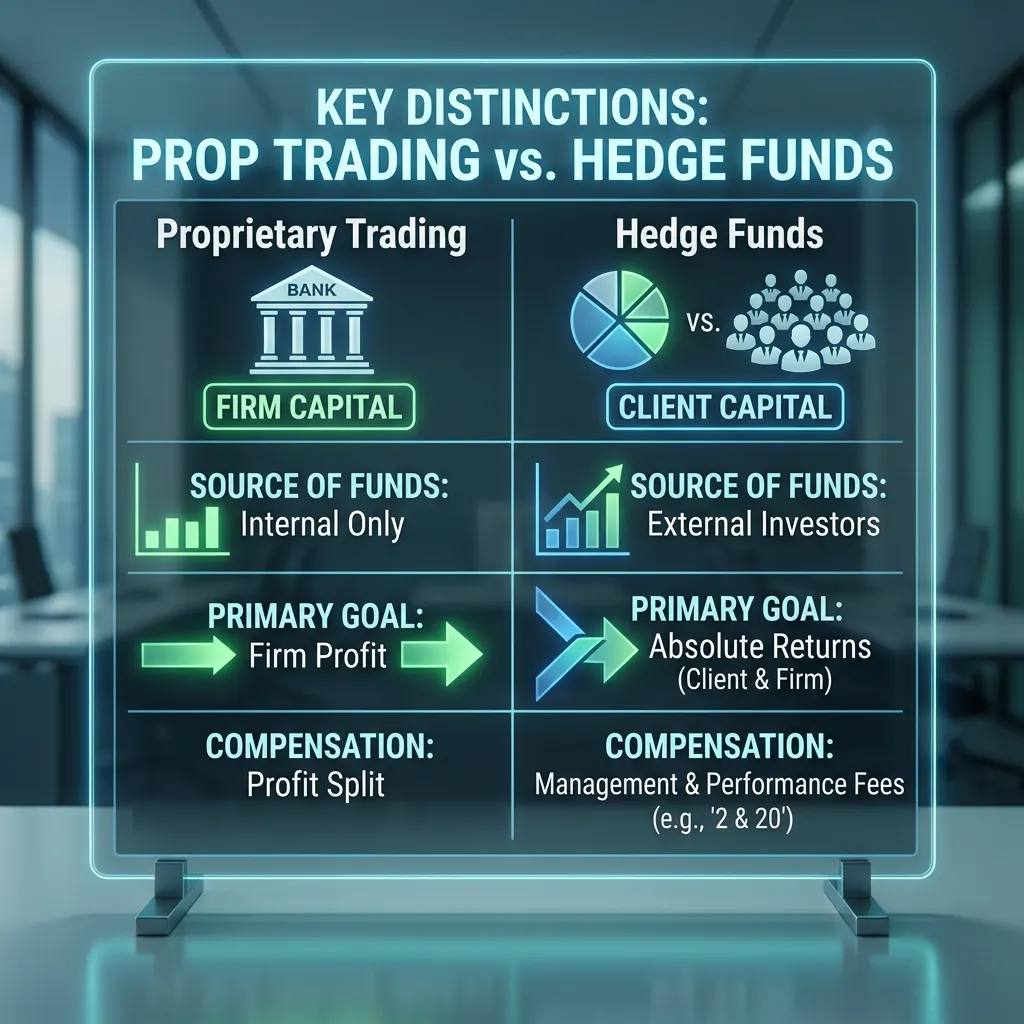
Proprietary trading is trading stocks, bonds, currencies, commodities or derivatives with the firm's own money instead of clients' money, so the firm keeps whatever it makes. Wikipedia's definition says roughly that. A prop firm is just any business built around doing it.
The word now covers two quite different businesses:
- Traditional prop firms hire traders, give them firm capital and pay salaries or a profit share. Many are trading houses and market makers.
- Retail "funded trader" prop firms sell evaluations online, fund the traders who pass, and pay them a large share of simulated or real profits.
Search "what is a prop firm" today and you almost certainly mean the second kind. So that's the one this guide is about.
Role of Prop Trading Firms in Financial Markets
Traditional prop trading firms add liquidity. They quote prices, take the other side of trades, and close tiny price gaps between markets. Banks did plenty of this until the Volcker Rule, part of the US Dodd–Frank reforms, reined in proprietary trading at deposit-taking banks. Independent trading firms? Never covered by that ban.
A retail prop trading firm plays a smaller part. Most of its funded accounts are simulated, so lots of its traders' orders never even reach the exchange. Its real job looks more like a skills marketplace: screen thousands of traders on the cheap, then give the consistent few access to capital they could never raise on their own.
Operations Within a Prop Firm
How Traders Operate Within a Prop Firm
At a retail prop firm you're an independent contractor, not an employee. FTUK's terms are blunt about it: the trader is a sub-contractor managing a firm account. Day to day, it goes something like this:
- The trader picks an account size and a rule set, then pays the evaluation fee.
- The trader places trades on the firm's platform (NinjaTrader, Tradovate, TradingView, TopstepX or a Rithmic platform for futures).
- The firm's risk system watches every position against the loss limits in real time.
- After passing, the trader requests payouts when the account meets the payout rules.
Nobody hands you a strategy or a desk. You bring the method. The prop firm brings the rules, the capital and a payout process.
Capital and Risk Management in Prop Firms
A prop firm guards its capital with hard limits, not trust. The big ones: a maximum loss (the drawdown), maybe a daily loss limit, a cap on contracts or lots, and sometimes a consistency rule. On a typical 50K futures account that maximum loss is $2,000–$2,500, and honestly, that's the real risk budget hiding behind the headline number.
| Control | What it does | Why the firm uses it |
|---|---|---|
| Maximum loss (drawdown) | Closes the account at a set loss | Caps the firm's exposure per trader |
| Daily loss limit | Stops trading for the day, or fails the account | Prevents one bad session from snowballing |
| Position limit | Caps contracts or lots | Stops a single oversized bet |
| Consistency rule | Limits how much profit one day can supply | Filters out one-lucky-day results |

Financial Aspects of Prop Firms
Profit Generation in Prop Firms
A traditional prop firm makes its profit from trading. A retail prop firm makes most of its money from fees, because most buyers fail the evaluation, plus its cut of funded traders' profits. We take that model apart in how prop firms make money.
For you, profit shows up as a payout. Topstep, say, lets funded traders keep up to 90% and wants five winning days of $150 or more before the first one. Other firms pay 100% of the first $10,000, or let you withdraw daily. Each with its own strings attached.
Evaluation Process for Traders
Think of the evaluation as the prop firm's hiring test. You trade a simulated account and have to hit a profit target, like $3,000 on Topstep's 50K Trading Combine, without touching the maximum loss. Pass and you're on to a funded account. Break a rule and you can usually reset for a fee and go again.
Only a minority pass. Prop Firm App puts the industry pass rate at about 10–15%. So the evaluation fee is your real cost of entry, and the right way to judge a firm is by the rules you're likely to survive. Account size? Mostly marketing.
Types of Prop Firms
Differences Between Futures Prop Firms and Others
A futures prop firm funds trading in exchange-listed futures contracts: E-mini and Micro E-mini index futures, crude oil, gold. Forex and CFD prop firms fund currency pairs and contracts for difference instead, usually on MetaTrader, cTrader or Match-Trader.
| Feature | Futures prop firm | Forex / CFD prop firm |
|---|---|---|
| Market | Central exchanges such as the CME; one order book | Broker or liquidity-provider prices |
| Position size | Contracts (minis and micros) | Lots |
| Typical platforms | NinjaTrader, Tradovate, TradingView, TopstepX, Rithmic | MetaTrader 5, cTrader, Match-Trader |
| Extra costs | Exchange market data at some firms | Swaps for overnight holds |
| US traders | Usually accepted | Often not accepted |
PropFirmWay points out that plenty of offshore forex and CFD firms won't take US clients, which is why US traders drift toward futures prop firms. Futures also come with exchange transparency. You get the same fill quality you'd get from any futures broker. The best futures prop firms page has the ones we'd shortlist.
Strategies in Proprietary Trading
Common Proprietary Trading Strategies
At traditional firms, proprietary trading strategies mean market making, arbitrage and statistical models running on very fast infrastructure. Retail prop traders mostly do discretionary or semi-automated day trading:
- Scalping: many short trades for a few ticks each, often on MES or MNQ.
- Trend following and breakouts: riding the session's main move after a range breaks.
- Pullback entries: buying dips in an uptrend or selling rallies in a downtrend.
- Order-flow trading: reading volume profile and footprint charts, which needs Rithmic-quality data.
- Swing trading: holding for days, where a firm's overnight and weekend rules allow it.

Whatever your style, the firm's rules will bend it. A strategy with a few big winning days needs a firm without a consistency rule. One with deep intraday pullbacks needs end-of-day drawdown, full stop.
| Subject | Relation | Object |
|---|---|---|
| Proprietary trading | uses | a firm's own capital, not client money |
| Volcker Rule | restricts | proprietary trading by US deposit-taking banks |
| Retail prop firm | sells | trading evaluations on simulated accounts |
| Futures prop firm | funds trading in | exchange-listed futures contracts |
| Funded trader | keeps | 80–100% of profits at most firms |
| Prop firm evaluation | is passed by | about 10–15% of traders (Prop Firm App) |
FAQ
How does prop firm work?
A prop firm works in three steps: pay for an evaluation, pass it by hitting a profit target without breaking the loss limits, then trade a funded account and keep most of the profit. Our guide to how prop firms work goes step by step, with real rules.
How much is a 100K prop firm account?
A 100K prop firm account costs about $650–$660 one-time if you skip the evaluation. Bulenox Fast Track was $648 and Tradeify Lightning Funded $660 when QuantVPS checked on 10 October 2026. A 100K evaluation is cheaper per attempt, but it often bills you monthly until you pass.
What happens if you lose money in a prop firm?
If you lose money in a prop firm account and hit the maximum loss, the account closes and the fee you paid is gone. That's it. You don't owe the firm the trading loss; Topstep says you'll never be on the hook for more than you put in. Most firms will let you reset, or just buy another evaluation.
How much do prop firms pay you?
Prop firms pay you 80–100% of the profit you make on a funded account at most futures firms, once you've met the payout rules. Topstep pays 90%, Bulenox Fast Track 100% of the first $10,000 and then 90%, and Earn2Trade 50–80% depending on withdrawal size. But most funded traders never reach a payout, so for a lot of people the honest answer is nothing.
Sources checked October 2026: Wikipedia: proprietary trading, Topstep: what is a futures prop firm, NinjaTrader: what is a prop firm, Goat Funded Trader: what's a prop firm, Axi: proprietary trading guide. Firms change rules often, so confirm every term on the firm's own site before you pay.